Note:
I use the term shaman for both female and male practitioners.
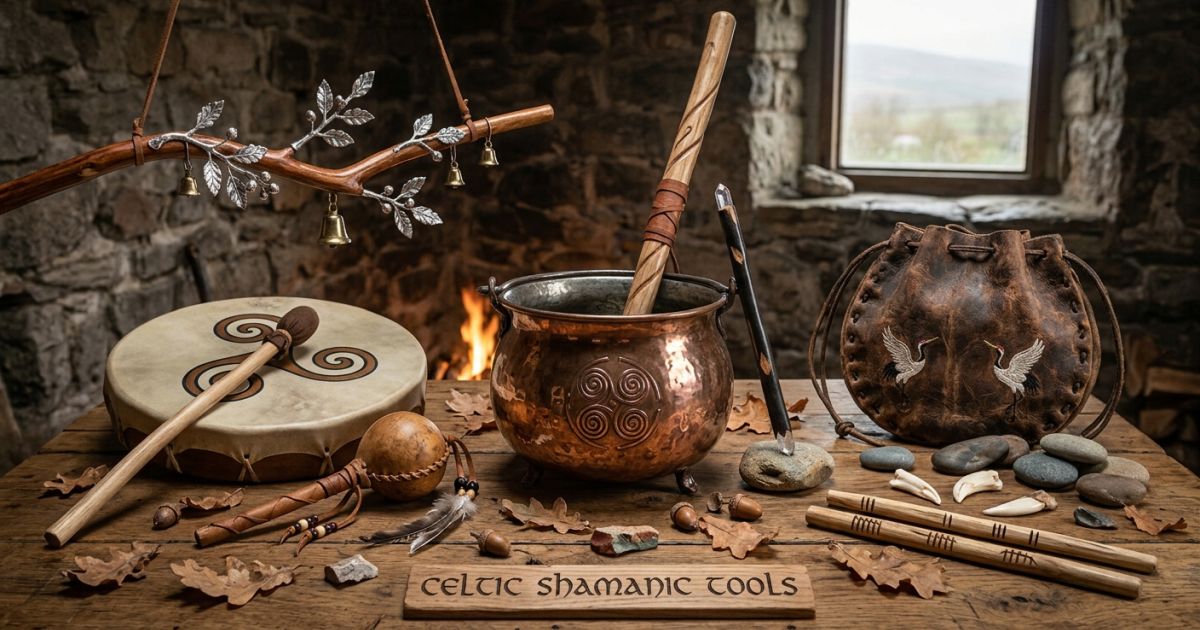
Shamanic tools are more than practical objects. They become companions in spiritual practice, symbols of particular powers, aids to meditation and journeying, and physical reminders of the relationship between you, the natural world and the unseen realms.
A drum may provide the heartbeat of a shamanic journey, often called ‘the Spirit Horse.’ The practitioner metaphorically rides energetically into the heart of the journey on the sonic waves of the drum.
A rattle can help establish rhythm and mark transitions. It can also be used to enable a shamanic journey, as well as to clear spaces and open up to spirit.
A silver branch may represent sovereignty, inspiration and the Otherworld. Often used like the rattle, but in order to invite silence and deep listening.
Whilst a crane bag carries the personal objects that form part of a practitioner’s spiritual life.
A wand or staff can serve as an extension of intention, authority and connection with the land.
It’s important to clarify between historically attested Celtic objects and those tools used by the contemporary Celtic Shaman. The ancient Celtic world was diverse, spanning many centuries and regions. We have archaeological evidence, classical accounts and medieval Irish and Welsh literature, but no single surviving text that sets out a universal system of Celtic shamanic tools.
Much of what is practised today is a modern spiritual interpretation inspired by Celtic mythology, folklore, historical artefacts and relationships with nature, as well as direct personal spiritual experience. With that distinction in mind, let us explore the tools and their possible roles in a modern Celtic shamanic practice.
- The shamanic drum
The drum is one of the most recognisable instruments used in contemporary shamanic practice. Although frame drums and other percussion instruments have a long history across many cultures, we should not assume that the specific shamanic journeying techniques used today were universal practices among ancient Celtic peoples.
For a modern Celtic shaman, the drum can represent the heartbeat of the Earth, the rhythm of life and the enduring pulse of the natural world.
Its principal uses include:
- Shamanic journeying:
- A steady, repetitive rhythm provides an auditory focus for guided visualisation and altered states of awareness.
- Grounding and centring: Playing the drum can help settle attention, encourage rhythmic breathing and bring awareness back to the body. Different beats and rhythms signify different parts of the journey.
- Ceremony and ritual: The drum can mark the opening, progression and closing of a working.
- Connection with the landscape: A practitioner might drum outdoors, allowing the rhythm to accompany contemplation of trees, rivers, hills or the sea.
- Celebration and seasonal observance: Drumming can be incorporated into gatherings marking the solstices, equinoxes and other seasonal festivals.
- In a journeying practice, the practitioner might begin with a comfortable rhythm whilst visualising a familiar natural entrance, such as a hollow tree, a cave or a path descending into the earth. A journey is different for each practitioner and their students.
One last thing: you can experience drumming by using a shamanic drumming audio track. This works perfectly, and they are even separated with different beats and speeds for the separate parts of a journey. These will include a beginning and middle, where you usually have silence and a call-back-home track.
I would recommend using a drumming track to anyone new to shamanic journeying, unless you have another person willing to drum for you, who understands the different elements and who can safely bring you back.
Many seasoned practitioners, myself included, use tracks all the time. I would recommend Sandra Ingerman’s audio’s. Having taken her course and worked with her core shamanic training, I can vouch for the high quality of her work.
- The rattle
The rattle is another useful instrument in modern shamanic work. It produces a sharper, more varied sound than the drum and is easy to carry, making it particularly practical for personal rituals and outdoor ceremonies.
Rattles can be made from wood, gourds, or leathers/manmade material. Their construction, sound and decoration can all contribute to their personal significance to you the practitioner..
How a Celtic shaman might use a rattle
Cleansing a ritual space: The sound can accompany an intentional transition from ordinary activity into sacred or reflective practice. A little known fact about rattling, is the shift in sound frequency changes the ions in the immediate atmosphere, altering positive ions into negative ions.
Now, this is one time when working with spiritual areas that you want to bring in the negative. The term negative ions refers to charge and not spiritual intent. Negative ions give the charged atmosphere you get during a thunderstorm, and this is perfect for spiritual work, especially shamanic work.
Shifting attention: A change in rhythm or a single decisive shake can mark the beginning or end of a meditation or journey.
Supporting journey work: The rattle can establish a rhythm, provide an auditory focus or signal a return to ordinary awareness.
Working with the elements: A practitioner may associate its movement and sound with wind, rain, flowing water or the rustling of leaves.
Closing a ceremony: A final series of shakes can signify that the ritual is complete and attention is returning to the everyday world.
Some practitioners use the rattle in a sweeping motion around the body or a space as part of a symbolic cleansing ritual. Performed correctly this can greatly aid in healing and chakra realignment.
- The silver branch
The silver branch is particularly fascinating because it has a meaningful connection with Irish mythological tradition. Unlike some of the tools discussed here, it has a recognisable literary counterpart in medieval Irish stories.
In Irish Otherworld narratives, a branch of silver bearing apples or bells appears as a wondrous object associated with the Otherworld and its mysterious inhabitants. One well-known motif is the silver branch that produces enchanting music and draws its hearers away from ordinary concerns towards the Otherworld.
The details vary between stories and translations, so it is worth treating the silver branch as a family of related mythological images rather than one standardised historical artefact.
We do know that early bards, especially in Ireland, carried a silver branch hung with bells and would shake it before beginning to speak or sing poetic verse. This action of shaking the branch told those all around that it was time to listen.
For a modern Celtic shaman, the silver branch can be a powerful symbol of the threshold between the familiar world and the world of spirit, inspiration and enchantment. It is perfect to announce to both yourself and to the other realms that you are ready to step away from the mundane and begin working with the invisible.
What does the silver branch represent?
The Otherworld: A reminder that Celtic mythology frequently presents the Otherworld as something that can touch or intersect with everyday existence.
Inspiration and enchantment: Its musical associations make it an appropriate symbol for poetry, music, storytelling and inspired insight.
The living tree: A branch links the heavens, the earth and the roots beneath the soil. It can symbolise the relationship between different levels of existence.
The call to journey: Its sound may serve as a ritual invitation to enter a period of contemplation, meditation or shamanic journeying.
The gift of the unseen: It can represent the wisdom, inspiration or perspective that a practitioner hopes to bring back from spiritual work.
How to work with a silver branch
A contemporary practitioner might use a small silver-coloured branch decorated with bells, could be placed on an altar, held during meditation or gently sounded to mark the beginning of a journey.
For example, the practitioner might hold the branch and reflect upon a question that cannot easily be answered through practical reasoning alone. The gentle sound of its bells becomes a reminder to listen patiently, remain open to possibilities and distinguish genuine insight from wishful thinking.
A silver branch should be made from silver or any other metal, but from a tree branch. Size depends on the individual’s personal taste and needs. For me, the perfect size is a large wand size. That is the distance from fingertips to elbow. Painted silver and drilled with six or perhaps nine holes. Then leather or material is pushed through and tied to small bells that are then suspended underneath. Small bells are threaded. The bells can be as elaborate as fancy mini bells or as simple as the kind you find at a craft shop.
It is all about what works for you and what you feel drawn to. When finished, you should be able to shake the branch and feel a difference in the place you’re standing. The silence that follows the shaking branch should feel quieter than normal; if inside, it might feel as though all of the furniture has been removed, leaving an echoing silence behind.
- The crane bag
The crane bag has a particularly interesting place in Irish mythology.
It is associated with Manannán mac Lir, the sea-associated figure of Irish tradition. In medieval Irish literature, the bag is described as being made from the skin of a crane and having a mysterious relationship with the tides. Its contents become visible or accessible according to the movement of the waters.
The crane bag is not simply an ancient equivalent of a modern practitioner’s pouch. In the stories, it is a wondrous object connected with mythological treasures and Manannán’s supernatural powers. The modern use of a crane bag as a personal spiritual container is an interpretation inspired by that tradition.
What does a crane bag mean in modern practice?
A contemporary Celtic shaman may carry a small pouch containing objects that have significance within their spiritual work. The energetic impact of such an item is the meaning it has and the objects it holds for the shaman.
These items could include:
- A stone collected from a meaningful landscape, perhaps a hag stone collected from a beach or a pebble from a place deemed sacred or powerful by the practitioner.
- A small fallen feather found naturally and gathered responsibly.
- A token representing a particular deity, ancestor or spiritual guide.
- A small piece of wood, a seed or a leaf.
- A miniature symbol of the sun, moon or a particular element.
- A small charm or personal object associated with a significant experience.
- A written prayer, intention or reminder of a spiritual commitment.
The contents are individual. One practitioner might carry only three objects, whilst another may develop a collection over many years.
The crane bag as a personal spiritual container
The deeper meaning of the bag lies in the idea of carrying what is necessary whilst keeping some things private.
A practitioner might have one pouch for journeying, another for outdoor ritual, or one bag that develops gradually as their spiritual practice evolves. There is no universal rule about how many items it should contain.
It can also be used as a reflective exercise. From time to time, the practitioner can empty the bag and consider each object:
- Why did I choose this?
- What does it remind me of?
- Does it still have meaning for me?
- What am I carrying that I no longer need?
This makes the crane bag an aid to self-knowledge as well as a practical means of keeping small items together.
Spiritual principle: The crane bag represents the wisdom we carry, the experiences that shape us and the things we choose to keep close. We might choose to gift an item we have carried for a long time, to a person who we feel has need of it.
Construction
The bag itself is generally made from leather, but can be made of other materials. Fully open, it is a circle with holes all the way around and a cord threaded through them, with a small object on the end to act as a closer; when the cord is pulled fully tight, it becomes a pouch and can be carried or hung on a belt. This can be designed however and wherever inspiration takes you.
- The wand
The wand is familiar from modern Paganism, witchcraft and ceremonial magic. It can also have a place in contemporary Celtic shamanism,
A wand is generally smaller and easier to handle than a staff. It may be a simple piece of wood, a naturally forked branch or a carefully crafted object decorated with carvings, stones or other materials.
What is a wand used for?
Directing energy, attention and intention A practitioner may point the wand towards a particular symbol, place or object as a way of concentrating their attention on the purpose of a ritual.
Marking boundaries
The wand may be used to trace a symbolic circle or indicate the limits of a ritual space. The circle is a modern ritual choice, not a requirement of Celtic spirituality.
Working with the elements
A practitioner may associate the wand with air, fire, growth or the living power of trees, depending on their personal system.
Blessing and dedication
The wand may be held whilst dedicating an object, making a commitment or expressing an intention for a particular working.
Meditation and visualisation
Holding the wand can provide a physical focus, helping the practitioner remain attentive to the purpose of a meditation.
Choosing a wand
Some practitioners choose wood according to folklore, personal experience or associations with particular trees. A naturally fallen branch may be especially appealing because it allows the practitioner to work with an object encountered in the landscape, without unnecessarily damaging a living tree.
If you do have to cut a branch from a living tree, ask permission first, before doing anything else. Wait, if you feel good, ask the tree to withdraw energy from that branch and cut or saw it off neatly. Then add some of your own saliva to the wound and thank the tree. you may wish to leave an offering such as dried herbs, tobacco, or similar. Whatever you use, be certain that it will not harm wildlife or the environment.
Note:
Only ever remove a branch with living energy still attached if you need it as a living wand and know why and how you will use it, not because it seems like a good idea.
- The staff
The staff is the wand’s larger companion, but its symbolism can be quite different. It is a practical walking aid, a symbol of authority and a powerful image of the traveller.
Walking sticks and staffs have obvious practical uses across many cultures. However, we should distinguish that general history from the more specific claim that an ancient Celtic shaman carried a staff with a fixed ritual purpose.
In a modern Celtic spiritual context, the staff can bring together the ideas of journeying, protection, guidance and connection with the land.
The staff in spiritual practice
The traveller’s companion: A staff supports walking on uneven ground and can become a symbol of the practitioner’s journey through life.
The axis between worlds: Its upright form can symbolise the connection between earth and sky, or between the visible world and the unseen.
Authority and responsibility: A staff can represent the responsibility that comes with knowledge, experience and spiritual leadership.
Grounding: Touching the staff to the earth can provide a physical point of focus during a period of contemplation.
Ceremonial marking: It can be placed at the entrance to a ritual space or used to indicate the beginning and ending of a ceremony.
Connection with the landscape: A staff carried on walks can become associated with particular places, experiences and seasonal changes.
Wand versus staff:
A wand is generally small, often the length measured from fingertips to elbow and no larger. It can be much smaller, depending on use, comfort and hand size. There are no hard and fast rules.
It is usually used to direct energy or intent, to focus energy. It is often placed on an altar
The staff is much larger. Like the wand, there is no set rule as to how big a staff is. It is at least as big as a walking stick/cane and will often be much larger. Think Gandalf in The Lord of The Rings.
It is associated mainly with journeys. It offers a solid tangible presence and support. A staff is carried through the landscape and is a statement piece. Can be used as an emblem of authority or of a commitment to a certain path.
A practitioner might carve a staff with spirals, leaves or other personally meaningful designs. If using ogham, the early Irish alphabet associated with inscriptions on stone and wood, it is worth learning the historical forms and meanings rather than inventing a script and presenting it as ancient. It is good to learn about any symbols you feel drawn to before using, as these may not be appropriate.
- The cauldron
The cauldron is one of the richest symbols in Celtic mythology, appearing in several Welsh and Irish literary traditions. It is associated with transformation, abundance, inspiration, regeneration and the mysterious powers of the Otherworld.
The Welsh story of Ceridwen and her cauldron of inspiration is particularly relevant to modern Celtic spirituality. In the tale, the cauldron is prepared to produce a draught of wisdom and poetic inspiration. The story of Gwion Bach, who receives its transformative gift, demonstrates how knowledge can arrive through unexpected and challenging experiences.
It is a universal Celtic symbol of the womb of the Goddess or Mother Nature.
Uses
It can be used in ritual, celebration and magic, depending on the needs and wishes of the individual practitioner. Much also depends on the cauldron itself. It can be a symbolic one made from pottery, for example and might sit happily on a desk or altar. On the other hand, it could be a solid cast iron one, made in the classic style, and this could even be used to cook in.
Be aware of material
As a practising Celtic shaman, I work with Feary and, because of this, do not use iron or steel in my work, as these can be harmful at worst and uncomfortable at best to the Fae. My choice is a copper cauldron, beautiful, useful and fully functional, while being safe for my fey guides and friends.