Note: This article originally appeared in Pagan Dawn Magazine.
Look at most divination systems in use today and you will see one or two shrouded in mystery and a vast majority newly created for the all too eager consumer market.
This isn’t necessarily a bad thing, as every system, every tool has to have its point of creation. However, when a divination system can link in to a deep heritage, it becomes more than simply a tool. It becomes a method for both spiritual development and personal interaction with the old ways.
Ogham today is very different from its rich beginnings as a language which has come down to us through myth and legend. We know Ogham is ancient, as it is to be found in many places such as Ireland, Scotland and Wales, carved into stones. Just how old the language is is impossible to say; some have ventured the idea that it could be a thousand or more years pre-Christianity. There was mention of a dark language once spoken in Celtic realms; could this be the spoken form of Ogham?
Like the Nordic Runes, which they are often compared with, the Ogham is an alphabet. The Ogham, pronounced O-Um or O-am, come in five sets of five. Technically, some people only class the original 20, as five we know were later additions. They are made up of sets of lines; these number between one and five and intersect a straight line. They resemble a tree trunk with branches coming off, and perhaps this was the intention.
Like the Runes, they can be used for divination, writing and magick. The Norse Runes are to be found carved into stone across Scandinavia, the Netherlands and
even Iceland. The Ogham has been termed the tree alphabet, because they are connected to the energy of trees. However, not every Ogham is a tree; some are plants, and so this term is really a misnomer.
Trees have always been seen as wisdom keepers, and not without reason. Unlike other life forms, trees remain in one place and life moves past them. They remain throughout the changing seasons, and many are of great age. These tree elders see, feel and touch the world in a unique way. For us to be able to interact with this energy is to interact with nature itself.
Much of the modern knowledge concerning the Ogham comes from Robert Graves’s The White Goddess, a book published in 1948. This information soon took root in the pagan groups which quickly sprang up following the repeal of the Witchcraft Act of 1951.
During the English Civil War, King Charles 1 is said to have used the Ogham to write secret messages. This traces the history back to the 1640s.
A manuscript dating from the 1400s, ‘The Book of Ballymote’ tells of the birth of the Ogham. This work speaks of Ogham as coming from Ireland and of being the creation of one Ogma son of Elatha. It goes on to say that it was intended for the learned apart; the noble class, inferring that it was not for the common woman or man. For a long time it was believed that Ogma was a Celtic noble.
References found in other sources trace the name to none other than the son of the Irish god Dagda, who was the father of wisdom. We have no knowledge as to
why this Celtic alphabet was created; simply that Ogma gave birth to it through his knife. A reference to it being first carved into either wood or stone.
It is known that originally there were only 20 letters in the alphabet and that a further five were added at a later date. This has been stated as giving the ability to translate foreign words such as Latin. This points to the script being a Druid language. Add to this, modern scholars now tend to agree with the ancient Greek and Roman writers that the term Druid was derived from two words: one meaning oak, Duir and the other Wid, meaning to know, which together formed a title for a person who has knowledge of the oak. As the oak was looked on in ancient times as the king of trees, does it not follow that ‘one who knows the oak’ would have knowledge of all trees?
The Druid, like the Ogham, is lost in legend; both existed in ancient times, but both have left scant knowledge of themselves behind. It stands to reason that Ogham was a script used by Druids and others such as Celtic nobles. As such, it comes down to us as a true lineage marker of ancient Celtic society. Here we have a direct link to an ancient world and its people
In the ancient world, divination was looked on as a sacred act played out before the gods and goddesses. These days many take the act as something trivial, and often divination becomes nothing more than a party game. To those of us who work with
energy, with spirit and with the goddesses, gods and old ones, divination is still very much a sacred act.
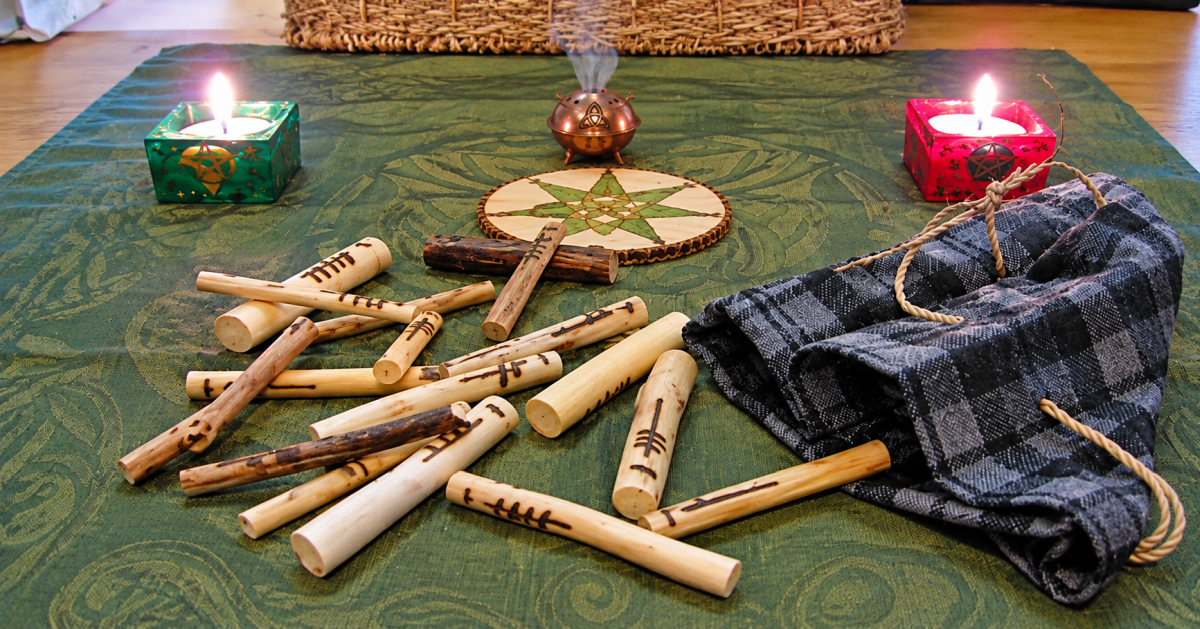
Most Ogham sets on sale today are made of wood, most but not all. There are also Ogham cards; these come in the shape of oracle decks and are just as viable as divining tools as their wooden counterparts, as both have the markings of the script.
Single Ogham wands/sticks/cards can be meditated with in order to attune to the parent tree/plant’s energy and knowledge base. Particularly useful for this are the wooden sets made from each of the named trees and plants. Each stick/disc in these sets is made from its named plant or tree, giving it a genuine energy link with it.
If you have seen the Ogham and wondered about it and its difficulty of use, rest assured that like any other divination system, it can be learned and enjoyed. It has a depth which runs through it and is anchored in antiquity, and as a tool can be as simple as a basic oracle, or as complex and as deep as the knowledge of trees. It is often overlooked in favour of Tarot and Runes, but is well worth the time and effort needed to get to know it. If you are on a Celtic path, this could be the very thing to enable you to feel more in tune with the changing wheel, for the trees are a very real, living, breathing part of the changing year.